
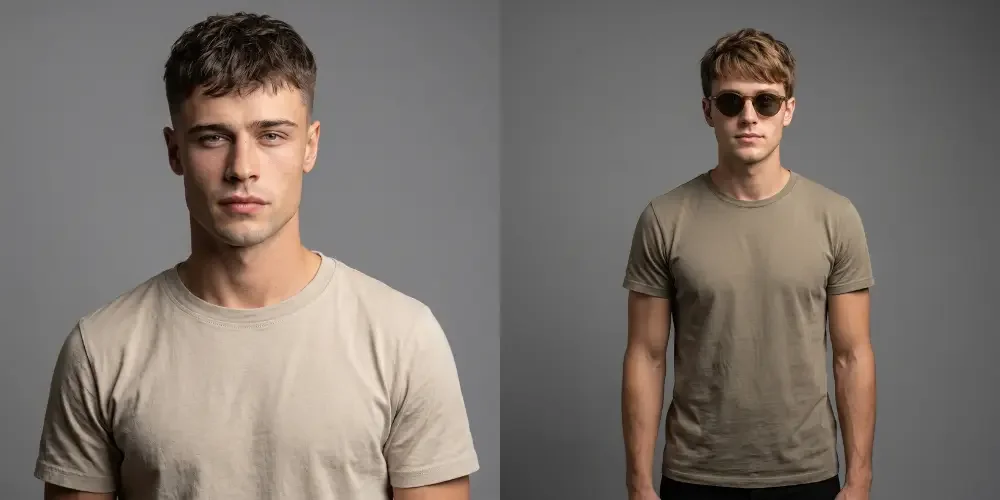
The main textured crop vs French crop difference is what happens at the front. A French crop usually has a deliberate fringe that comes forward. A textured crop looks more broken up, with movement through the top and often a less defined fringe. Either can have a fade.
These names get used loosely. We have had two guys bring in almost the same photo, one asking for a French crop and the other for a textured crop. The picture tells us more than the label.
What’s the Difference Between a Textured Crop and a French Crop?
From the front, the French crop gives you a clear forward shape. The fringe may be straight, softened, or slightly uneven, but it is part of the look. A textured crop puts more attention on separated pieces and movement. The fringe can be lighter or pushed in a different direction.
From the side, either haircut can look very similar.
What Is a French Crop?
It is a short haircut with the top directed toward the forehead and a fringe at the front.
Some French crops look very sharp, with a precise line. Others are softer and easier to wear with a cowlick. If you like the cut but not the heavy straight fringe in a photo, tell us. We can discuss a lighter version.
What Is a Textured Crop?
It is a short top cut and styled to show movement instead of one solid shape. The hair may fall forward in pieces or lift slightly at the front.
“Texture” is not permission to thin every section. On fine hair, too much separation can reveal the scalp. On thick hair, removing weight in selected areas can stop the top from looking like a block.
Textured Crop vs French Crop: Key Differences
| Feature | French crop | Textured crop |
|---|---|---|
| Fringe | More deliberate forward edge | Often broken or less defined |
| Top | Compact, generally directed forward | Separated pieces with more movement |
| Shape | Neat, structured outline | Softer, less uniform finish |
| Daily styling | Often simple direction and control | Usually some finger styling for separation |
Fringe
This is where to start. Point to where you want the front to land when it is dry. A fringe that looks short in a photo may drop much lower on straight hair or spring up on curls.
Texture and Movement
A French crop can have texture, and a textured crop can have a fringe. The distinction is which feature leads the look. Ask whether the top should sit neatly forward or move in smaller, less uniform sections.
Overall Shape
The sides change the impression. A low taper or scissor-cut side softens it. Show us the side view as well as the front.
Styling Requirements
If your hair already falls forward, a French crop may take little direction after washing. A textured crop often needs a minute with your fingers to bring out the pieces. Neither is automatically a wash-and-go cut.
Which Haircut Is Better for Thick Hair?
Both can work. A thick fringe gives a strong front edge but can sit heavily on the forehead. A textured crop can break that mass into pieces.
We also look above the ears. Thick hair that puffs at the sides can make a short crop look wider than the reference photo.
Which Works Better for Straight, Wavy, or Curly Hair?
Straight hair shows a crisp fringe clearly and can hold a clean French crop. It may need cut-in movement for a textured finish. Wavy hair brings some of that movement on its own, although the fringe will not form a perfect straight line without styling.
Curly hair can be cropped too. We judge the fringe after the curl has dried and sprung up. If you want a particular forehead length, we should agree on the dry result, not just the wet length in the chair.
Which Haircut Is Easier to Style Every Day?
The easier one follows your natural growth direction. If the front wants to fall forward, keeping a simple French crop shape can be quick. If it parts or lifts on its own, a looser textured crop may be less of a fight.
Tell us if you use a dryer, product, both, or neither. A photograph taken after ten minutes of styling is not an honest picture of what your hair will do on a rushed Tuesday.
Can You Get a French Crop or Textured Crop With a Fade?
Of course. You can pair either with a low taper, a mid fade, a close fade, or longer scissor-cut sides. The side treatment changes the contrast; it does not rename the top.
If you do not want skin showing, say that before the cut. We can keep the crop and build a softer outline around it.
How Often Do These Haircuts Need a Trim?
Watch the fringe and the sides. A defined French crop can lose its shape when the front reaches your eyes. A looser textured top may tolerate more growth. A close fade shows its grow-out sooner than a longer side.
Book when the part you care about no longer looks like the haircut you asked for.
What Should You Tell Your Barber?
For a French crop: “I want the top to fall forward and the fringe to finish here.” For a textured crop: “I want the top to break into pieces, without a heavy straight fringe.” Then show the side length and fade level you like.
Bring a front and side photo. Mention cowlicks and how much you are willing to style. That lets us adapt the reference to your actual hair.
Textured Crop vs French Crop: Which Should You Choose?
Choose the French crop if you like a compact, forward shape with a noticeable fringe. Choose the textured crop if you want the top to look more relaxed and move in pieces. We can combine a soft fringe with some texture if the middle ground suits you best.
At Salt City Barbershop, show us the part of the photo you like. We will talk about the front, sides, and daily styling before choosing how to cut it.
FAQs
Is a textured crop the same as a French crop?
They overlap. A French crop usually puts more emphasis on a forward fringe; a textured crop emphasizes separated pieces and movement.
Which is better: a French crop or textured crop?
Neither is universally better. Choose the front shape you like and the amount of styling that suits your routine.
Which crop haircut works best for thick hair?
Both. A barber can control the weight of a French crop fringe or create movement through a textured top.
Can you get a textured crop without a skin fade?
Yes. A low taper or longer sides can work with the textured top.
Is a French crop easy to maintain?
Often, especially if your hair naturally falls forward. The fringe and any close fade will still need trimming as they grow.